Most prerendering case studies show one before-and-after. This one has three phases, because we accidentally ran the experiment twice: prerendering went live, then a change on our side quietly switched it off for four months, then we found the problem and turned it back on.
The site is xirkle.com, a large JavaScript single-page app with tens of thousands of dynamically generated pages. Every number below comes from its Google Search Console.
The short version
The problem: an app that crawlers couldn't read
Like most React, Vue or Svelte apps, xirkle.com sends a nearly empty HTML page and builds everything else in the browser with JavaScript. Visitors never notice. Crawlers do: AI crawlers such as GPTBot, ClaudeBot and PerplexityBot don't run JavaScript at all, and Googlebot only renders it in a second, delayed pass. With tens of thousands of pages, that delay adds up.
On May 31, Search Console reported 16,845 pages indexed and 70,493 not indexed. Google knew the pages existed; it just wasn't adding most of them.
Phase 1: prerendering goes live (early June)
In early June we put xirkle.com behind renderit.now. Requests from known crawlers get a fully rendered HTML copy of the page; visitors keep the normal app. It's the "dynamic rendering" pattern Google itself has documented, and the content is the same for crawlers and people, so it isn't cloaking.
Three weeks later, on June 21, indexed pages were at 33,747. On July 6, 34,165, roughly double the May figure.
The "not indexed" count fell even more, from 70,493 to 6,224, but we don't claim all of those pages were indexed. The total number of pages Google knew about also dropped, from about 87,000 to about 40,000, so part of that fall is Google cleaning up duplicates and dropping URLs from its list, not new indexing. The honest headline number is the indexed one.
Phase 2: prerendering quietly stops (July to November)
In early July, an infrastructure change on our side left xirkle.com pointing at a rendering endpoint that no longer existed. Nothing visibly broke for visitors, so nobody noticed. Crawlers simply went back to getting the empty JavaScript shell. The same change also stopped the site's XML sitemaps from loading, which we only discovered in November.
Indexing didn't drop overnight. Search Console showed indexed pages still climbing to about 38,000 in early August, as Google worked through pages it had already rendered and queued. Then the trend turned. By November 5, the last report before the fix:
- Indexed: 27,100, down about 29% from the August peak
- Not indexed: 42,700, up from 10,662 in July
- Search impressions (the blue line below): from about 1,100 a day in early August to almost none by mid-September
Because the sitemaps broke at the same time, we can't say how much of the decline came from losing prerendering and how much from losing the sitemaps. Both make it harder for Google to find and keep a JavaScript site's pages, and both were fixed together.
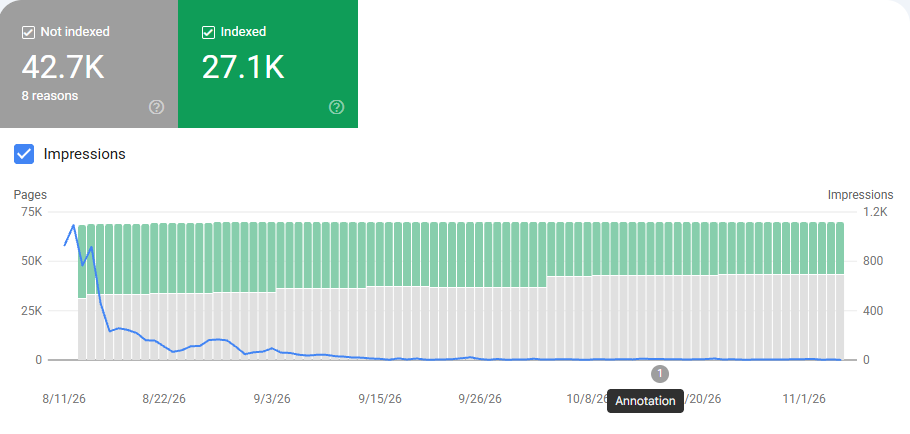
Search Console page indexing report, Aug 11 to Nov 5, 2026, while prerendering was off. Green: indexed. Grey: not indexed. Blue line: daily search impressions. Shared with the full permission of the xirkle.com team.
Phase 3: prerendering comes back (November 7)
On November 7 we traced the problem, pointed xirkle.com back at the live renderer and confirmed that Googlebot was getting full pages again. The next day we fixed the sitemaps; Search Console read them successfully and listed 87,164 URLs.
Crawlers reacted within hours. Renderit's logs show the pages they requested in the first evening, nearly all of them pages that hadn't been rendered before:
| Hour (ET), Nov 7–8 | Pages rendered for crawlers |
|---|---|
| 7 pm | 368 |
| 8 pm | 675 |
| 9 pm | 620 |
| 10 pm | 1,671 |
| 11 pm | 1,127 |
| 12 am | 1,398 |
That's more than 5,800 pages in about six hours, after four months in which crawlers got almost nothing from those same URLs. Whether that turns back into indexed pages is the real question, and the answer takes weeks, not hours.
All the numbers
| Date | Indexed | Not indexed | Prerendering |
|---|---|---|---|
| May 31 | 16,845 | 70,493 | Not yet |
| Jun 21 | 33,747 | 6,224 | On since early June |
| Jul 6 | 34,165 | 10,662 | On (stopped days later) |
| Early Aug | ≈38,000 | ≈31,000 | Off; Google still working through earlier renders |
| Nov 5 | 27,100 | 42,700 | Off; sitemaps also failing |
| Nov 21 | Coming soon | Coming soon | On again since Nov 7; sitemaps fixed Nov 8 |
What we take from it
- For a large JavaScript site, prerendering moved the number that matters. Indexed pages doubled while it was on, and declined while it was off.
- The effects lag. Gains took about three weeks to show; losses took about a month to start. Don't judge prerendering, or an outage, on a few days of data.
- Silent failures are the dangerous ones. Visitors saw a perfectly working site for four months while crawlers got an empty one. If you prerender, check what bots actually receive now and then, not just what your browser shows.
- Sitemaps and rendering work together. Sitemaps tell Google which pages exist; rendering decides what it finds when it gets there. Losing both at once hurt more than either would alone.
If you run a React, Vue or Svelte site
- Check what crawlers get from a real page without JavaScript. Our free Bot Visibility test shows it side by side, and Search Console's URL Inspection shows Google's own view.
- Make sure your sitemap URL returns XML, not your app's HTML page. That's a common trap for single-page apps.
- Watch "Indexed" in Search Console over weeks, not days, and note the date of any change you make so you can line it up later.
Methodology and caveats
This is an observational case study, not a controlled experiment. Indexing depends on many things besides rendering: content changes, internal links, site authority, Google's own updates and, here, the sitemap outage that overlapped with the prerendering outage. We report Search Console's numbers as shown on each date. The May, June and July figures were recorded from Search Console at the time; Search Console keeps only about three months of history, so the screenshot covers August to November. The early-August figures are read from that chart and are approximate; the others are exact from the report. The crawler counts come from renderit.now's render logs and include all crawlers, not just Googlebot. Results vary by site, stack and how each webmaster or developer sets things up.
xirkle.com is a renderit.now partner site. Search Console screenshots are shared with the full permission of the xirkle.com team. We'll update this article with the November 21 data whether it shows a recovery or not.
See what crawlers get from your site
Run a free side-by-side test, then try renderit.now free for 14 days on Vibe Coder. No code changes to your app.
Test my site free →